Case Study 2 · Integrated Marketing Communications
Making nostalgia an experience.
For our final-year Integrated Marketing Communications module, my group developed and pitched a 360° launch campaign for a proposed ticketed immersive experience inspired by Toy Story 5. The concept invited visitors to feel toy-sized inside an oversized version of Andy’s bedroom, supported by a London-wide “Lost Toys Trail”, brand partnership ideas and an integrated promotional plan.
Andy’s
Bedroom.
01 / The brief
A 360° campaign built around a physical experience
Our group was tasked with designing and pitching an end-to-end campaign over a maximum eight-week promotional window, including an agency-style 30-minute presentation and competitive Q&A. The presentation planned a seven-week active campaign lifecycle and a total managed budget of £1.5m, allocated across digital, outdoor, experiential and paid media activity.
Our central idea was an immersive, ticketed experience at London’s Southbank Centre. Visitors would be “shrunk to toy size” and explore a 10x-scale version of Andy’s bedroom, with oversized furniture, interactive zones and photo opportunities.
02 / Audience & positioning
Connecting nostalgia with family experiences
The strategy balanced two audience groups: young adults aged 18–30 who grew up with Toy Story and enjoy social, immersive experiences; and families with children, looking for memorable days out. We used buyer personas to explore motivations such as nostalgia, quality time, discovering new experiences and shareable moments, alongside barriers such as cost and travel logistics.
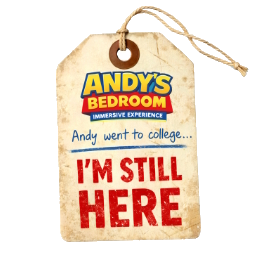
The campaign’s emotional narrative was “Andy went to college… I’m still here.” We played on the idea of toys being left behind to tap into memories of the original film and give the event a recognisable story across the different touchpoints.
In our competitor analysis, we compared immersive and family attractions, including The Paddington Bear Experience, Mundo Pixar, the Warner Bros. Studio Tour, SEA LIFE London and other leisure destinations. A positioning map considered the emotional impact and level of interaction offered by different experiences.
03 / The integrated idea
Taking the story beyond the venue
Rather than relying on one advert or one venue, the proposed campaign connected outdoor media, social content, influencers, email, a booking website, experiential activations and brand partnership concepts. Each touchpoint had a role in moving people from awareness to ticket purchase and then advocacy.
The Lost Toys Trail
A proposed QR-enabled trail linking recognisable London locations back to the main experience.
Social content journey
Pre-event curiosity, during-event experience content and post-event sharing.
- Outdoor: proposed 3D-style billboard creative and transport advertising to build awareness and social buzz.
- Digital: a dedicated booking website concept, email marketing and paid social activity to support consideration and conversion.
- Experiential: the main bedroom installation, a Lost Toys Trail and a themed “Lost & Found” coffee van.
- Influencers: proposed creator activity to build early interest and provide social proof.
04 / Partnerships & participation
Giving audiences a reason to interact
My group developed three partnership concepts designed to add memorable interactions to the experience and extend its reach beyond the venue.
Hands-on brand moments
Personalisation, building and limited-edition product ideas from the group presentation.
Oversized set design
Photo moments and interactive zones intended to encourage participation.
- Converse personalisation zone: visitors could personalise shoes, creating a hands-on emotional touchpoint.
- LEGO build zone: a proposed interactive “Andy’s Bedroom” build area intended to increase dwell time and social sharing.
- Krispy Kreme limited-edition boxes: a proposed themed product with QR codes linking to ticket booking.
These were proposed partnership ideas in an academic pitch; no actual commercial partnership is implied.
05 / Customer journey
Mapping touchpoints to the path to purchase
Using the customer journey framework discussed in the presentation, we linked campaign activity to five stages: awareness, consideration, conversion, retention and advocacy.
Outdoor placements, the Lost Toys Trail and teaser social content were designed to build curiosity and initial recognition.
Influencer previews, social channels, search content and the coffee-van activation were intended to answer “Why should I go?” and build interest.
Booking website concepts, QR codes, email reminders and urgency-led content were designed to make ticket purchases easier.
Booking emails and practical visit information were proposed to reduce uncertainty and help customers prepare for the experience.
Photo moments, personalised interactions and a campaign hashtag were intended to encourage visitors to share their experiences.
06 / Budget & measurement
Linking investment to objectives
The presentation set out a proposed campaign budget of £1.5m. Individual channel slides included illustrative allocations such as £600,000 for billboard activity, £400,000 for our Disney+ homepage takeover, £300,000 for station escalator wraps, £15,000 for bus advertising and £14,400 for social media creative/activity. These figures are from my group’s proposal, not verified market quotes or money spent.
We proposed SMART objectives including selling 75% of tickets, generating five million impressions, reaching three million social views and initiating 15,000 QR interactions over the campaign period. These were targets for the hypothetical campaign, not achieved outcomes.
Measurements were linked to each touchpoint across the campaign lifecycle:
- Awareness: Impressions and reach.
- Trial Activity: QR scans and website traffic.
- Conversion: Click-through rates and ticket purchases.
- Engagement & Advocacy: User-generated content and social mentions.
07 / Reflection
What the project demonstrated
This project brought together audience segmentation, competitor analysis, brand positioning, creative concept development, channel planning, budget allocation and KPI selection in one integrated proposal. It also highlighted the complexity of making a large experiential campaign feel consistent across many different touchpoints, and the need to balance creative ambition with operational cost, ticket sales and measurable objectives.